
How can AI reduce warehouse costs?
AI can reduce warehouse costs by shortening pick routes, improving stock placement and forecasts, planning labor, checking inventory and damage, choosing packaging, predicting maintenance needs and coordinating robots. Savings come from avoided labor, carrying costs, returns, materials and downtime—not from speed improvements alone.
Evidence snapshot: DHL reported up to 30% higher productivity and up to 50% less employee travel at individual sites using IDEA. These overlap and are not total warehouse cost reductions. Our separate picking example produces €42,000 annual net savings under its stated assumptions.
Last updated: · Reported results and illustrative scenarios are distinguished below.
Warehouse AI cost savings at a glance
All euro figures below are illustrations, not promised or measured customer savings. They are annual gross avoided costs before AI fees and implementation, except the fully loaded robotic-picking example. Do not sum the rows: benefits can overlap.
| AI use | Improvement and evidence status | Annual savings example |
|---|---|---|
| 1. Smarter pick routes and order batching | Up to 30% higher picking productivityReported by DHL at individual sites; not a 30% cost reduction. | €60,000 / yearWorked example; assumptions below. |
| 2. Dynamic slotting | 10% fewer paid picking hoursIllustrative pilot outcome, not an industry benchmark. | €50,000 / yearWorked example; assumptions below. |
| 3. Demand forecasting and inventory optimization | 20% less average inventoryIllustrative scenario, not a promised reduction. | €40,000 / yearWorked example; assumptions below. |
| 4. Workload forecasting and shift planning | 20% less overtime spendingIllustrative scenario, not a reported company result. | €24,000 / yearWorked example; assumptions below. |
| 5. Computer vision for inventory checks | 60% fewer manual counting hoursIllustrative pilot outcome; not a published performance claim. | €30,000 / yearWorked example; assumptions below. |
| 6. Damage and fulfillment checks | 25% fewer avoidable claimsIllustrative scenario, not an Amazon result. | €30,000 / yearWorked example; assumptions below. |
| 7. Better packaging decisions | €0.30 less packaging cost per orderIllustrative unit saving, not an Amazon result. | €60,000 / yearWorked example; assumptions below. |
| 8. Predictive maintenance | 10 fewer downtime hours a yearIllustrative scenario, not a reported DHL result. | €20,000 / yearWorked example; assumptions below. |
| 9. Warehouse robot fleet orchestration | 10% improved robot travel timeAmazon’s stated DeepFleet improvement; not a total-cost saving. | €20,000 / yearWorked example; assumptions below. |
| 10. Vision-guided robotic picking | €0.15 less per successful pickIllustrative fully loaded comparison, not a Dematic result. | €75,000 / yearWorked example; assumptions below. |
How to read the figures: Company-reported improvements are identified as such. Euro amounts are worked examples with stated assumptions, not forecasts for your warehouse. Examples are annual gross avoided costs before AI fees and implementation costs, except where explicitly labelled net. Do not add them together: several uses can reduce the same costs.
Where AI earns its place on the warehouse floor
Every unnecessary walk, oversized carton and avoidable return has a cost. AI earns its place when it reduces one of those costs consistently enough to cover its own price. Start with a measurable problem, good operational data and a small pilot.
These ten uses are ranked by our assessment of practical savings potential and ease of starting in a typical warehouse. This is an editorial priority list, not a universal ROI league table. The best choice depends on your labor costs, order mix, inventory and existing automation.
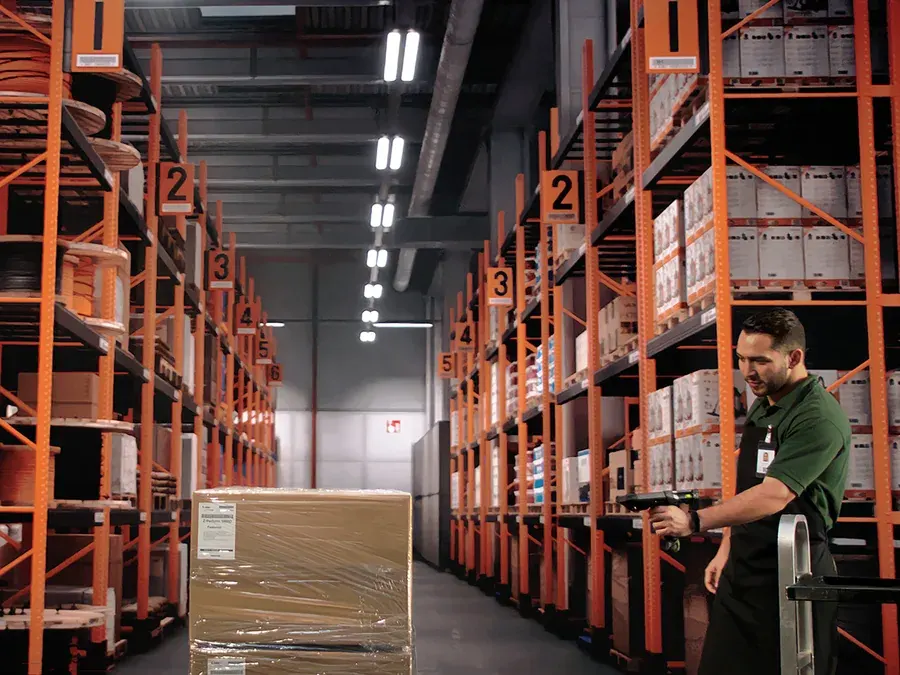
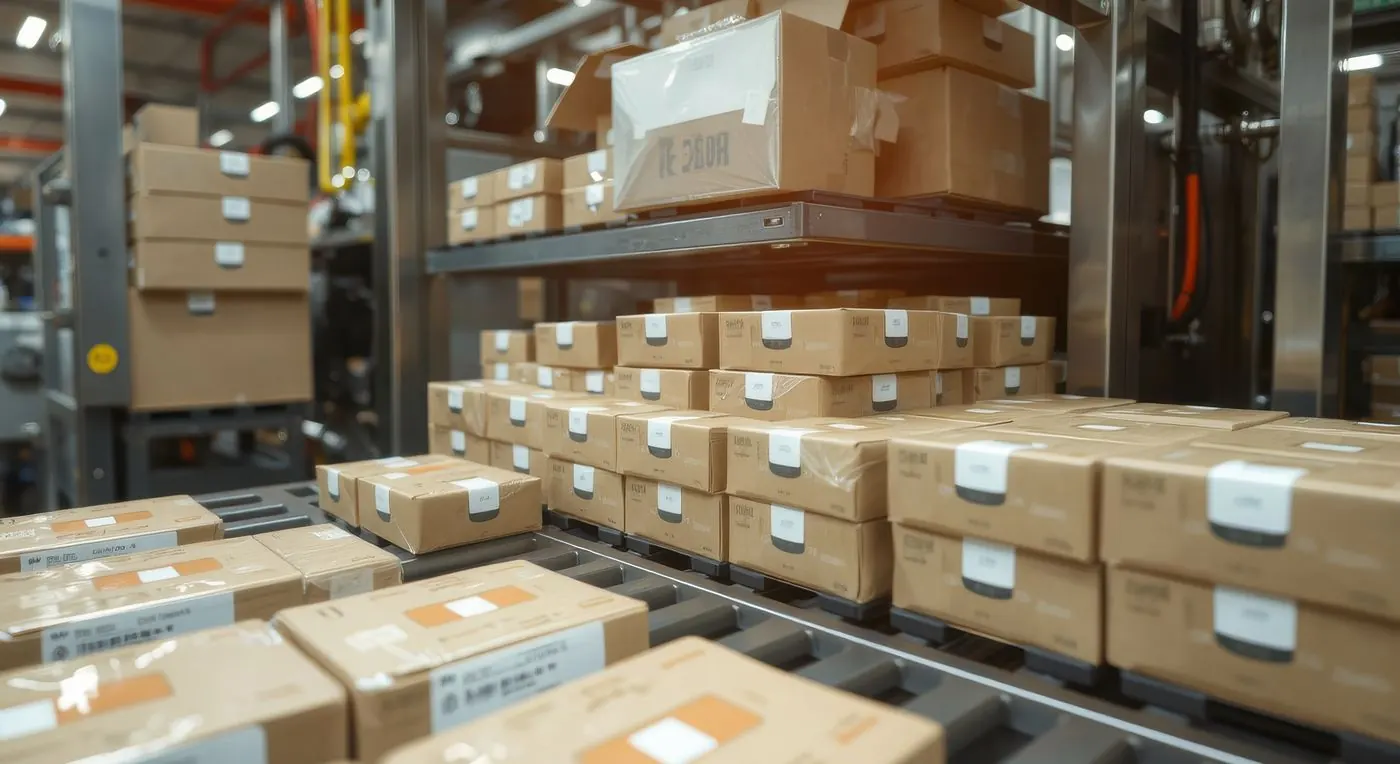
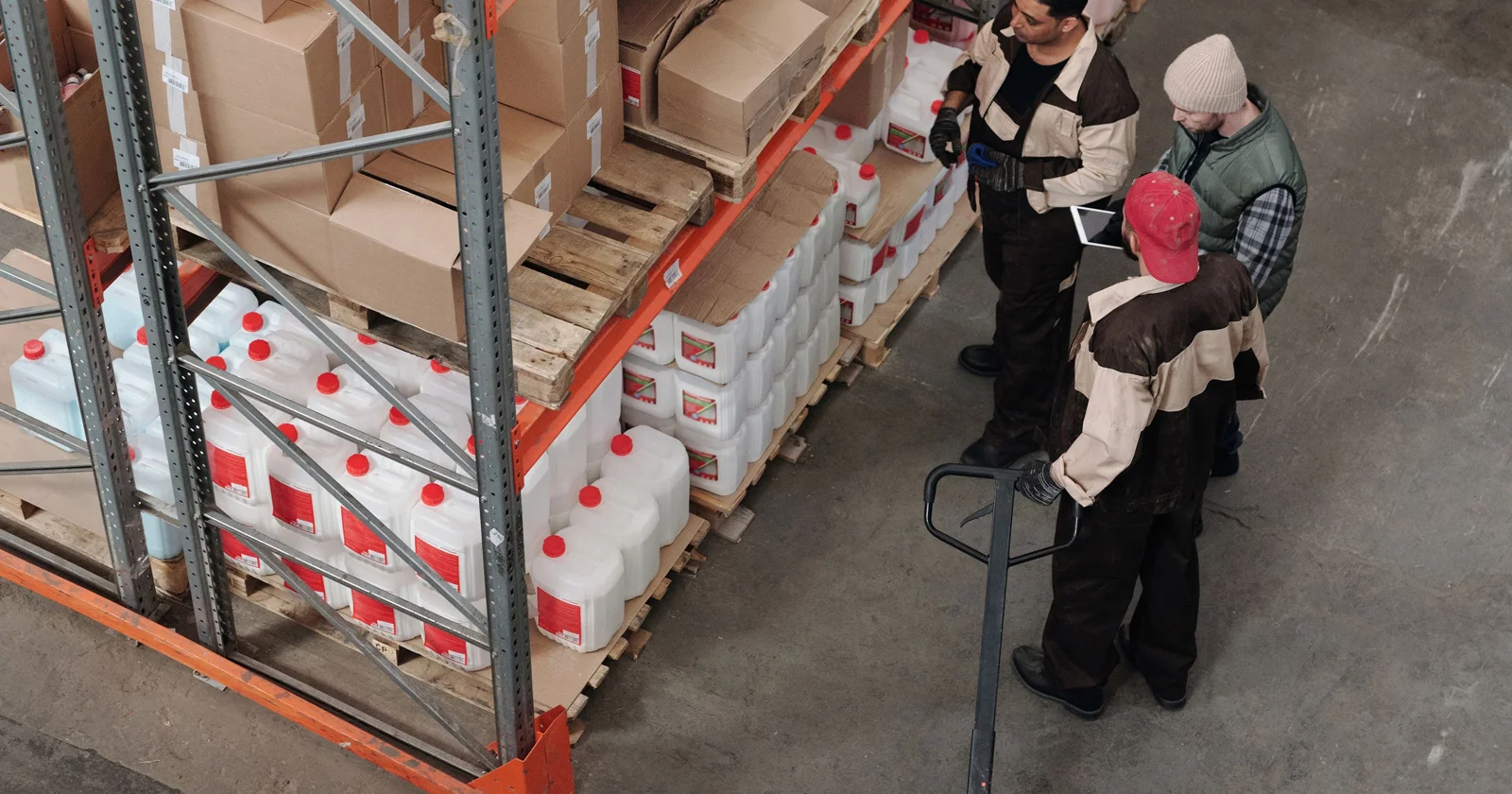
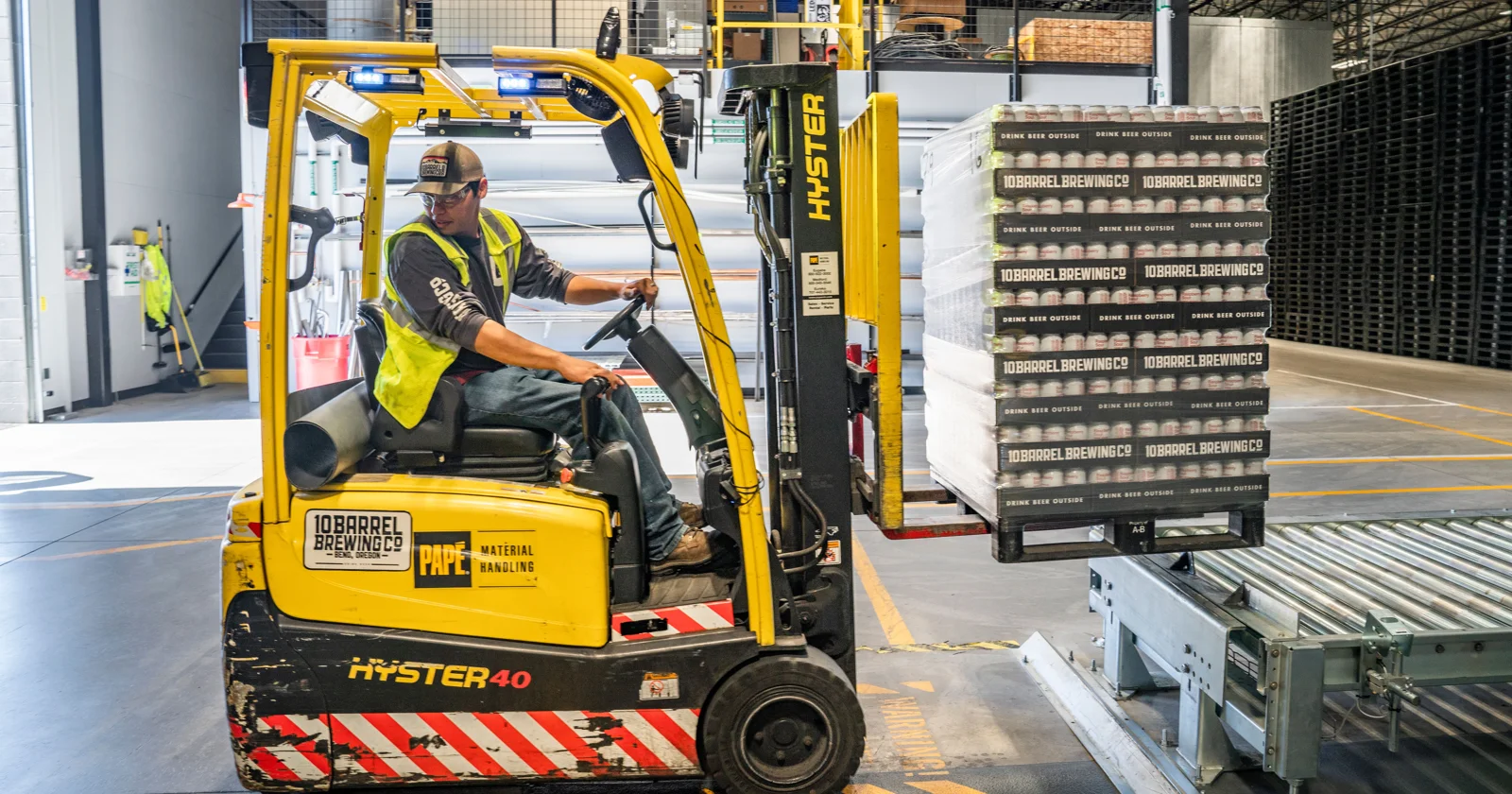
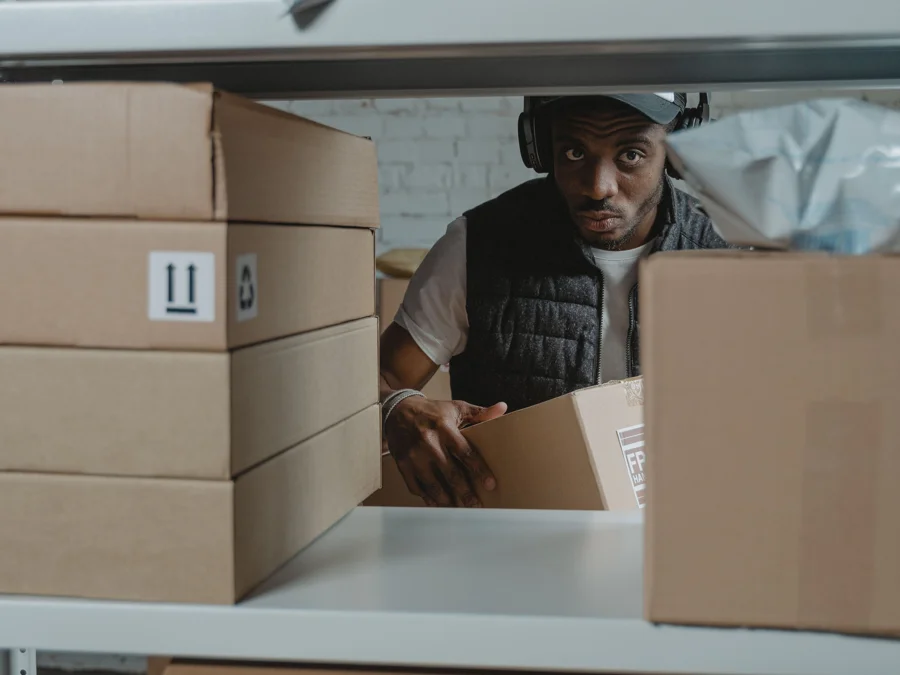
Some applications combine machine learning with conventional optimization. Ask what the AI adds beyond your WMS rules, scanners and existing reports. The photographs show warehouse work; they do not document the cited AI deployments.
01. Smarter pick routes and order batching
Where you save: Picking labor and overtime.
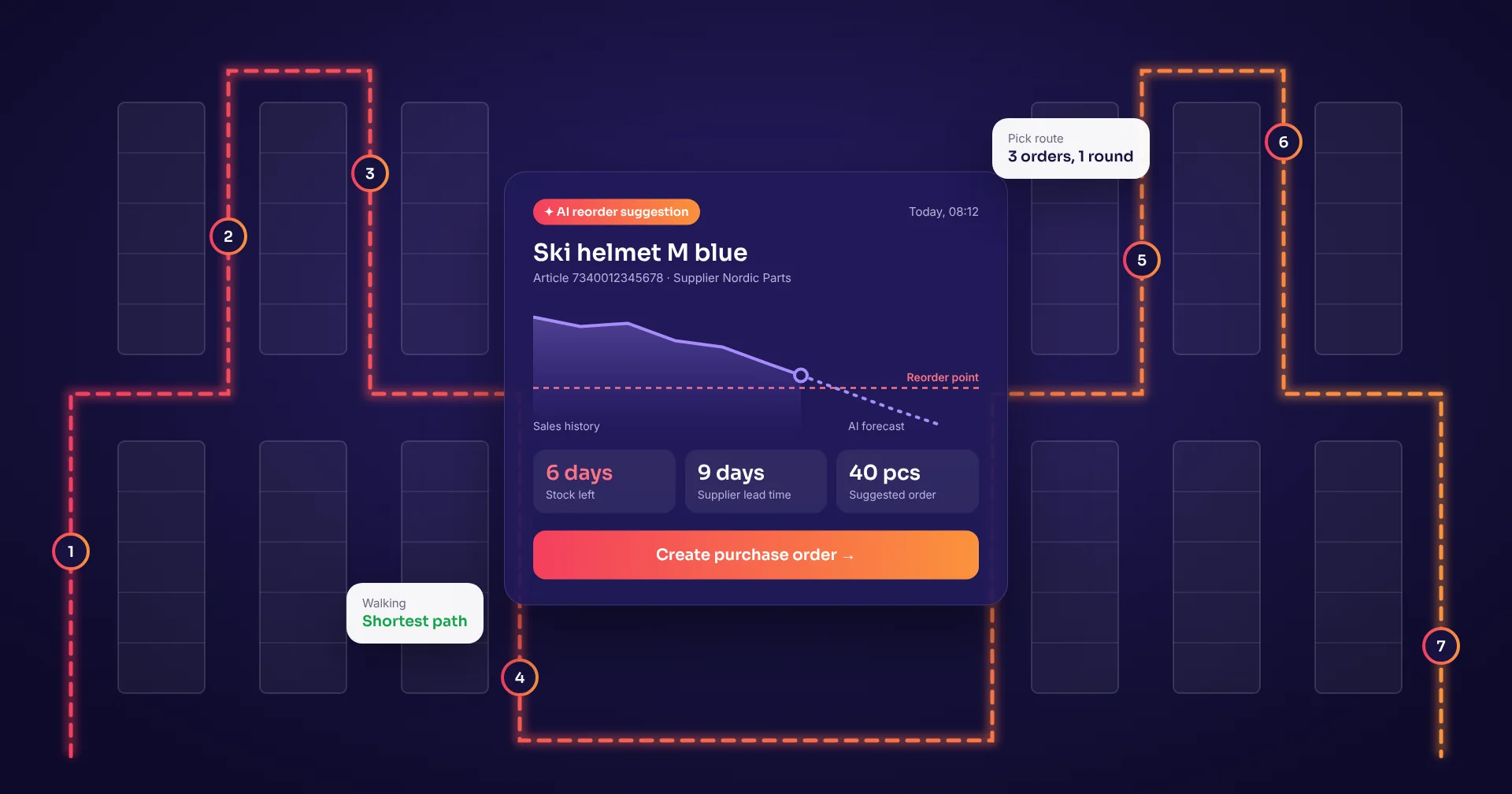
AI can group compatible orders and sequence picks around actual demand and congestion. DHL reported up to 50% less employee travel and up to 30% higher productivity at individual sites in its first IDEA deployments. These are site-specific results, not a universal benchmark. Read the DHL case study.
Prove the saving: Pilot one picking zone. Compare paid hours per 1,000 lines at the same accuracy and service level. Faster picking creates cash savings when it reduces overtime, agency hours, or future hiring.
02. Dynamic slotting: put stock where the work is
Where you save: Travel, replenishment and handling.
Use a model to identify changing SKU demand and order affinities, then recommend where items belong. Keep fast movers close to useful pick paths and frequently ordered combinations near one another. The business case is fewer touches, not simply a prettier warehouse map.
Prove the saving: Track walking time and replenishment touches per line, then subtract the labor needed to move stock. Compare AI recommendations with a straightforward velocity-based slotting rule before paying for added complexity.
03. Demand forecasting and inventory optimization
Where you save: Carrying costs, write-offs and emergency freight.
Machine learning can use sales patterns, seasonality and lead-time data to improve replenishment decisions. IBM describes these inventory applications. Better forecasts can lower avoidable excess stock while protecting availability.
Prove the saving: Measure inventory value, ageing stock and stockouts together. Released working capital is a one-time cash benefit; annual savings come from lower carrying costs and fewer write-offs. Do not count the entire inventory reduction as recurring profit.
04. Workload forecasting and shift planning
Where you save: Overtime and unnecessary temporary labor.
Predict the receiving, picking and packing workload by shift from orders, inbound plans and past processing times. Managers can staff likely peaks earlier instead of reacting with expensive last-minute cover. IBM outlines AI-supported scheduling and planning.
Prove the saving: Compare overtime and agency spending per comparable order volume. Keep skill coverage, breaks and service targets in the plan; fewer hours only help if orders still leave on time.

05. Computer vision for inventory checks
Where you save: Counting labor and stock discrepancy investigations.
Cameras can help count visible stock or parcels and flag unexpected changes for review. DHL identifies automated counting as a computer-vision use. Target repetitive counts where visibility is good, rather than assuming a camera can see every item behind every pallet.
Prove the saving: Test one suitable aisle. Record count hours, discrepancy rates and false alerts. Require confirmation before stock adjustments, and compare the total cost with barcode-based cycle counting.
06. Damage and fulfillment checks before dispatch
Where you save: Returns, replacement shipments and rework.
Computer vision can inspect outgoing items and direct suspicious packages to a person. Amazon describes AI-based damage detection. Catching a problem before dispatch avoids sending an expensive mistake to the customer.
Prove the saving: Measure preventable claims and reshipment cost against inspection labor and false rejects. Validate performance on your own products: glossy packaging, occlusion and changing lighting can affect results.
07. Better packaging decisions
Where you save: Cartons, void fill and dimensional freight charges.
AI can recommend packaging using product characteristics and feedback about damage. Amazon uses a Package Decision Engine for this purpose. The opportunity is to protect the order with less material and less unused space.
Prove the saving: Track packaging plus freight cost per order alongside damage rates. Start with high-volume product families. Simple box-sizing rules may already capture much of the benefit, so measure the additional gain from AI.
08. Predictive maintenance for critical equipment
Where you save: Unplanned downtime and emergency repairs.
Models can flag unusual operating patterns from machine sensors and maintenance records. DHL highlights computer vision for monitoring assets and alerting maintenance teams. Focus on conveyors or sorters whose failure stops dispatch, rather than monitoring everything equally.
Prove the saving: Track avoided stoppages, repair spending and unnecessary interventions. Use a meaningful baseline and include sensor installation, technician time and software fees in the calculation.
09. AI orchestration of warehouse robot fleets
Where you save: Congestion, equipment time and capacity expansion.
Coordinate robot routes and priorities so machines spend less time waiting or blocking one another. Amazon says its DeepFleet model will improve robotic fleet travel time by 10%. That is a stated operational improvement, not a 10% reduction in total warehouse costs. Read Amazon’s announcement.
Prove the saving: This suits sites that already operate substantial robot fleets. Measure productive missions per robot-hour and queue time. Confirm that saved time increases useful throughput or avoids an equipment purchase.
10. Vision-guided robotic picking
Where you save: Labor on repetitive, suitable pick tasks.
AI-enabled vision helps robotic arms identify and grasp individual items. Dematic describes this approach. A stable, high-volume assortment offers a clearer business case than a small warehouse handling constantly changing awkward products.
Prove the saving: Test representative SKUs and exceptions. Compare fully loaded cost per successful pick, including capital or lease cost, integration, maintenance and human recovery. Throughput alone does not establish payback.
Calculate the saving before you scale
Use actual paid costs, not hours multiplied by an assumed saving. Capacity freed up can be valuable, but it becomes a cash saving only when spending falls or a planned expense is avoided.
- Annual net saving = verified avoided costs minus software, support, maintenance and other recurring costs.
- Include integration, equipment and training in the one-time investment.
- Simple payback in months = one-time investment ÷ annual net saving × 12.
- Keep quality, safety and on-time dispatch at least as good as the baseline.
A worked example
Illustrative figures only: a picking pilot eliminates 200 paid overtime hours a month at €25 per hour. That saves €60,000 a year. Software and support cost €18,000 a year, leaving €42,000 in annual net savings. With €35,000 in one-time implementation costs, simple payback is 10 months. If those hours are merely reassigned, the same cash-saving claim does not apply.
Start with one expensive problem
For a manual warehouse, pick routing, slotting and packaging are useful first candidates because their costs are easy to observe. Inventory planning deserves priority when excess stock dominates your balance sheet. Robot orchestration and robotic picking make more sense when volume and existing infrastructure justify the investment.
Establish a baseline, run a representative pilot and compare the result with a simpler alternative. Scale only after the saving survives peak periods, exceptions and the full cost of ownership.
Tags
Want to explore a better warehouse workflow? Bring your biggest cost problem and your current process to the conversation.
Book a demoResearch checked 14 October 2026. Sources are linked beside the relevant claims. Reported company results are self-reported and may not transfer to another operation. This article does not claim that these ten AI features are included in Raptool WMS.
Frequently asked questions about AI in warehousing
What are the best uses of AI in warehousing?
For many manual warehouses, pick routing, dynamic slotting, inventory forecasting and packaging decisions are useful starting points. Choose the process with the largest measurable avoidable cost. Robot orchestration and robotic picking depend more heavily on volume and infrastructure.
How much money can AI save in a warehouse?
Savings depend on local volumes, costs and implementation. In this article’s illustrative picking example, avoiding 200 paid overtime hours a month at €25/hour saves €60,000 a year. Subtracting €18,000 in recurring software and support costs leaves €42,000 annual net savings. This is a worked example, not a forecast.
Does AI make warehouse picking 60% faster?
This article does not substantiate a 60% faster picking claim. DHL reported up to 30% higher productivity at individual sites and up to 50% less employee travel in its first IDEA deployments. The 60% figure elsewhere in this article is an illustrative reduction in manual counting hours, not a reported picking result.
How do you calculate warehouse AI ROI?
Annual net saving equals verified avoided costs minus recurring AI costs. Simple payback in months equals one-time investment divided by annual net saving, multiplied by 12. Do not count reassigned hours as cash savings or add overlapping benefits together. The worked example has €35,000 one-time costs and €42,000 annual net savings, giving 10-month simple payback.
Do these AI uses require warehouse robots?
No. Forecasting, slotting recommendations, picking optimization and packaging decisions can be evaluated without buying robots. Robotic picking and fleet orchestration require suitable automation, integrations and a separate investment case.