Overview
In short: a small business can use AI in two places that pay back fast. First, demand forecasting tells you when to reorder each product, and how much, before it runs out. Second, smarter pick lists batch orders together and route pickers along a shorter path, so they walk less. Both work best when every stock movement is scanned.
AI in the warehouse sounds like something for giant retailers with robots and data teams. It is not. Some of the most useful gains for a small business come from two everyday jobs: ordering stock before it runs out, and picking orders without wasted walking. Both run on data you already have, such as sales history, stock levels, lead times and pick locations. Here is how AI helps with each, and how to start without a big project. A mobile warehouse management system is where that data is collected.
Why running out of stock hurts so much
An empty shelf costs more than one lost sale. The customer may buy from someone else next time too. Retail research firm IHL Group put the global cost of out-of-stocks and overstocks at about 1.77 trillion US dollars in 2023. For a small business the numbers are smaller, but the pain is the same. Cash is tied up in slow sellers while the fast sellers run dry.
Most small teams reorder from a gut feeling or a fixed minimum level. That works until sales change. A product gets popular, a season starts, or a supplier gets slower, and the old minimum is suddenly too low.
How AI helps you reorder before stock runs out
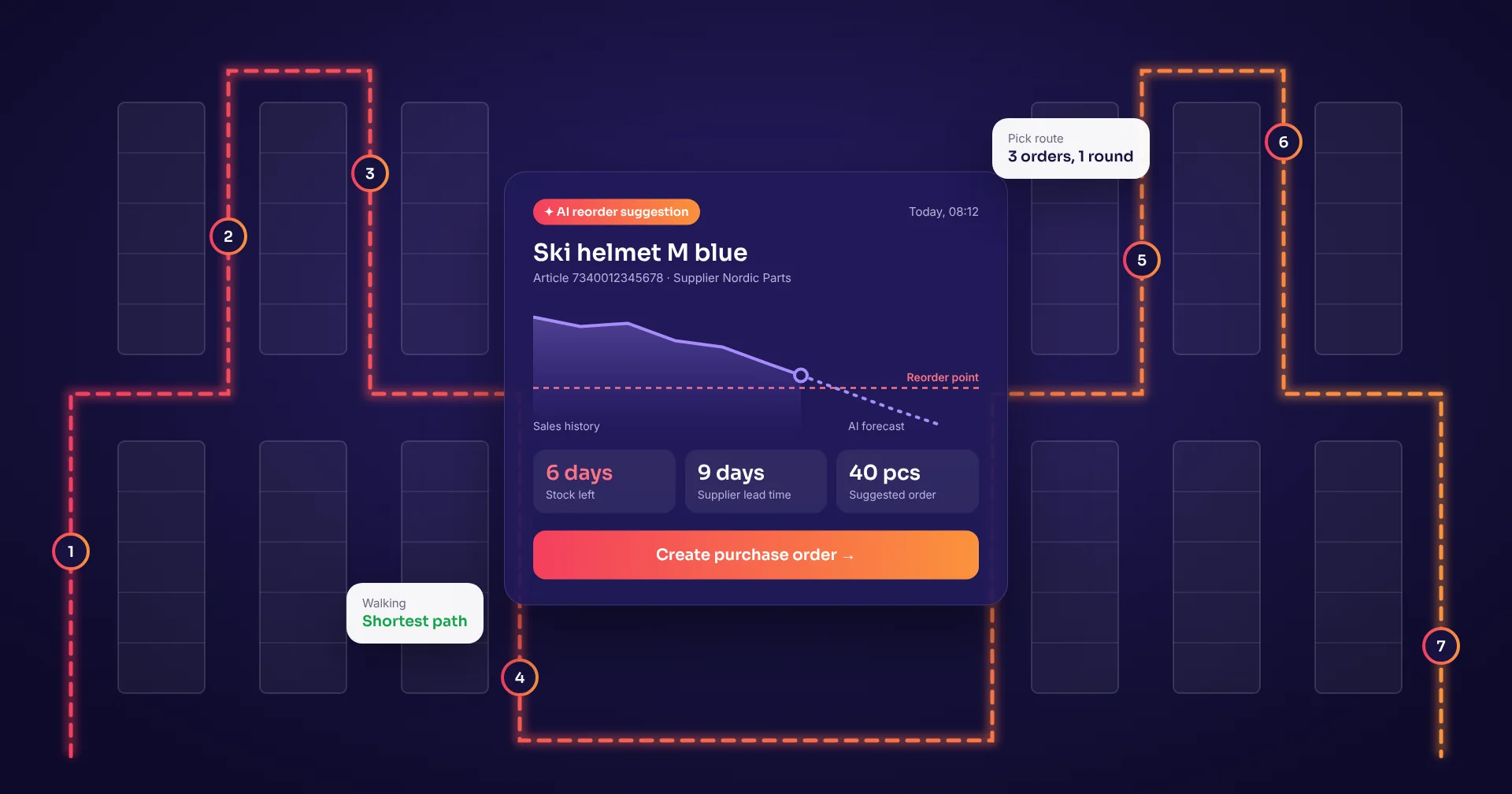
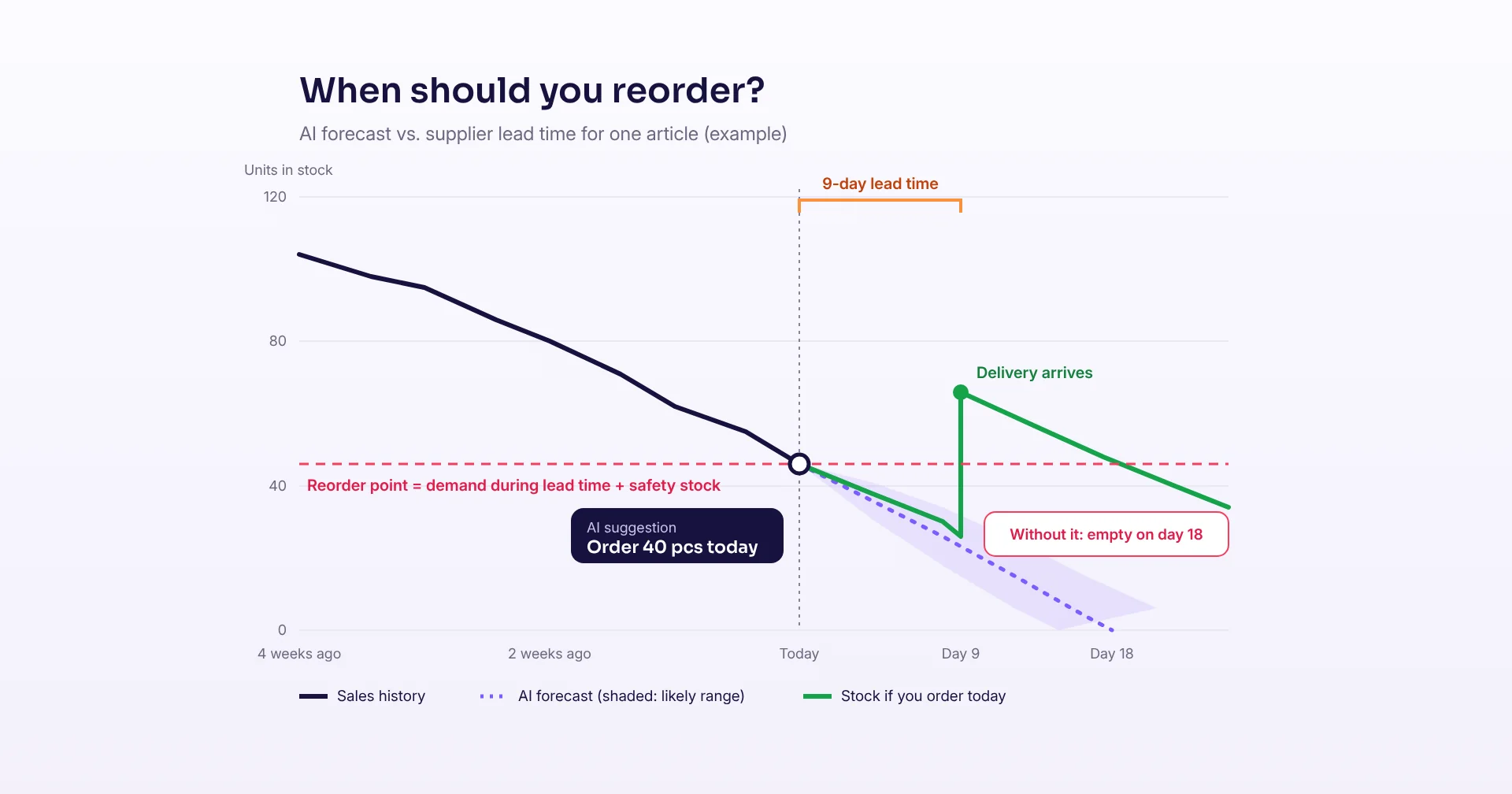
AI forecasting looks at your sales history and finds the patterns a person misses: weekly rhythms, seasons, slow growth, and products that sell together. It then estimates how many days of stock you have left and compares that with how long your supplier takes to deliver. When the two get close, it tells you to order, and how much. McKinsey has reported that AI-driven forecasting can cut forecasting errors by 20 to 50 percent and reduce lost sales from stock-outs by up to 65 percent.
You do not need years of perfect data to start. A year of sales, a lead time per supplier and a minimum level per article is enough for a useful first version. The key is that the forecast feeds a clear action: a suggested purchase order that someone checks and sends.
- Set a minimum per article, plus a separate minimum for the pick face
- Record a realistic lead time for each supplier
- Review suggested orders weekly, not just when something is empty
- Count fast sellers often so the forecast starts from true stock
- Watch overstock too: AI should also tell you what not to buy
How AI makes picking faster: cut the walking
In most warehouses, picking is the most expensive job. A well-known review of warehouse research by de Koster and colleagues estimates that order picking can account for as much as 55 percent of warehouse operating cost, and that travel is often the largest part of a picker's time. Every metre walked between shelves is time not spent picking.
That is where AI and smart rules pay off fast. Three ideas make the biggest difference:
- Batch orders: pick several small orders in one round instead of one by one
- Route the picker: follow the shortest path through the shelves, not the order of the lines
- Slot smartly: move fast sellers close to packing and at waist height, the golden zone
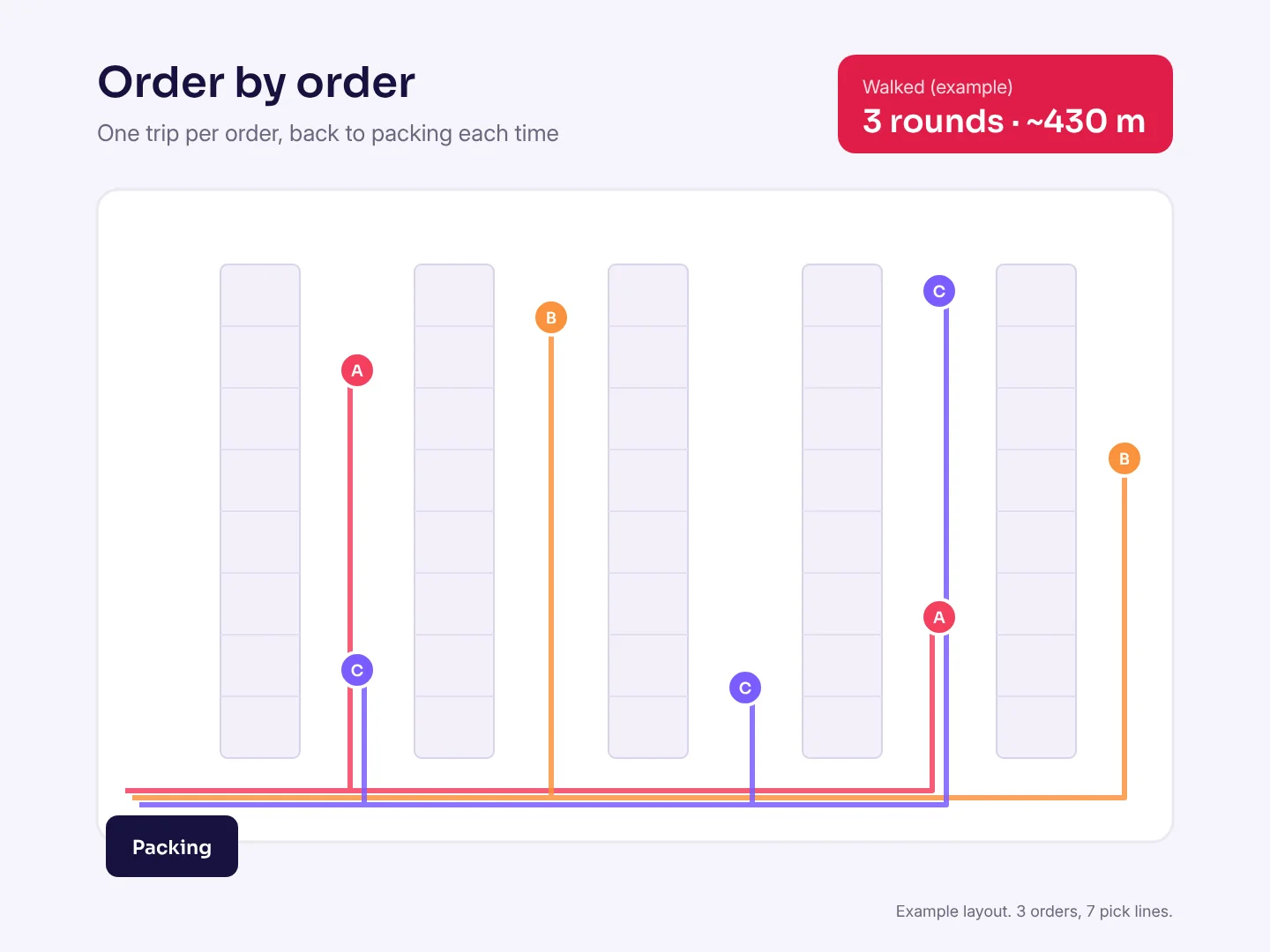
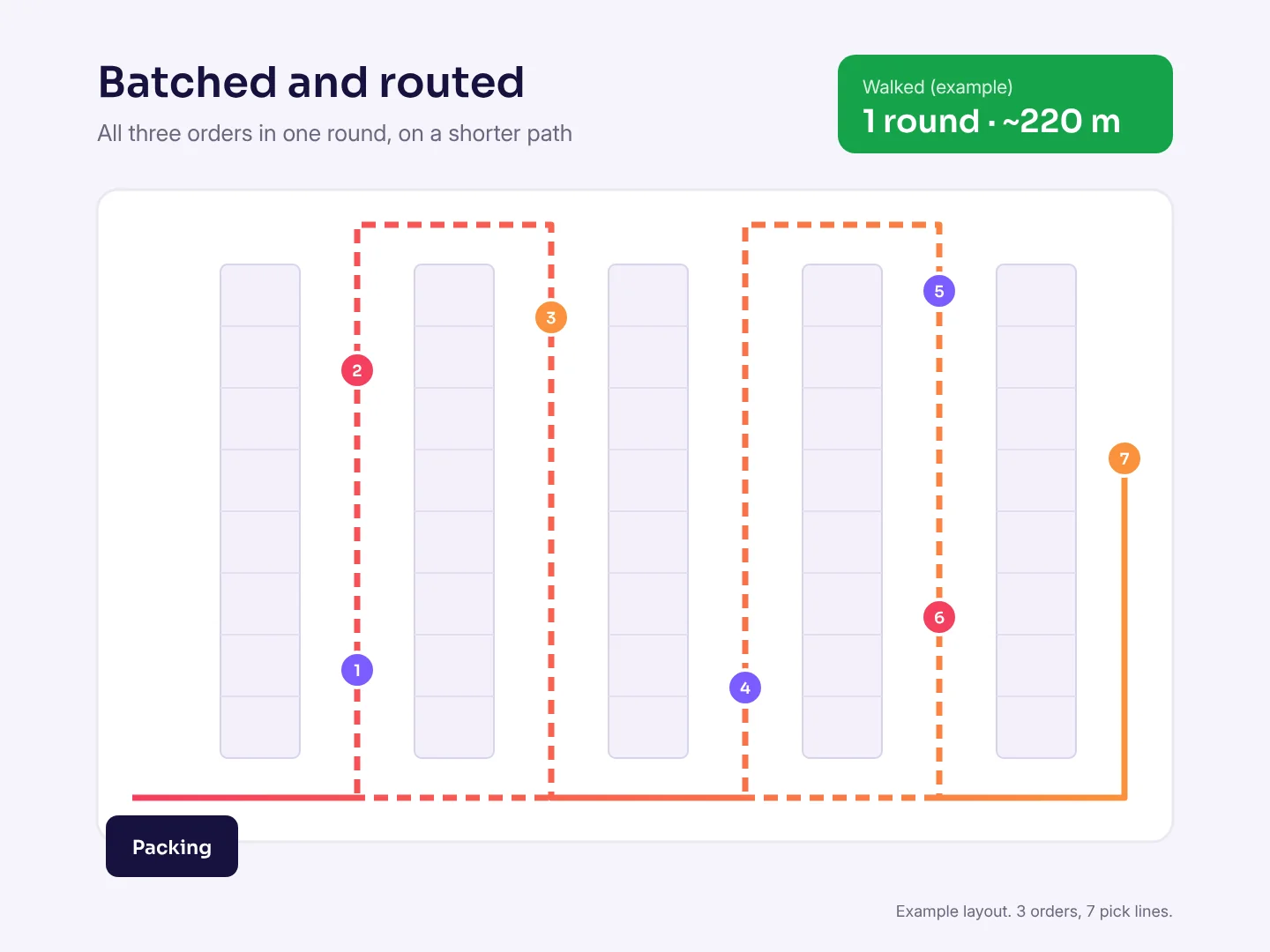
The same research shows that even simple batching beats picking orders in the order they arrive, and that a basic aisle-by-aisle route can be 7 to 33 percent longer than the best route. AI takes this further. It learns which products sell together and places them near each other, and it suggests slotting changes as demand shifts with the seasons.
Start with clean, scanned data
AI is only as good as the data it learns from. If stock levels are wrong, the forecast is wrong. If locations are not scanned, the route is a guess. So the first step is not AI at all. It is scanning every movement: receiving, put-away, picking and counting. When each step is scanned, your system knows what you have, where it is and how fast it moves. That is exactly what forecasting and pick optimisation need.
How Raptool helps
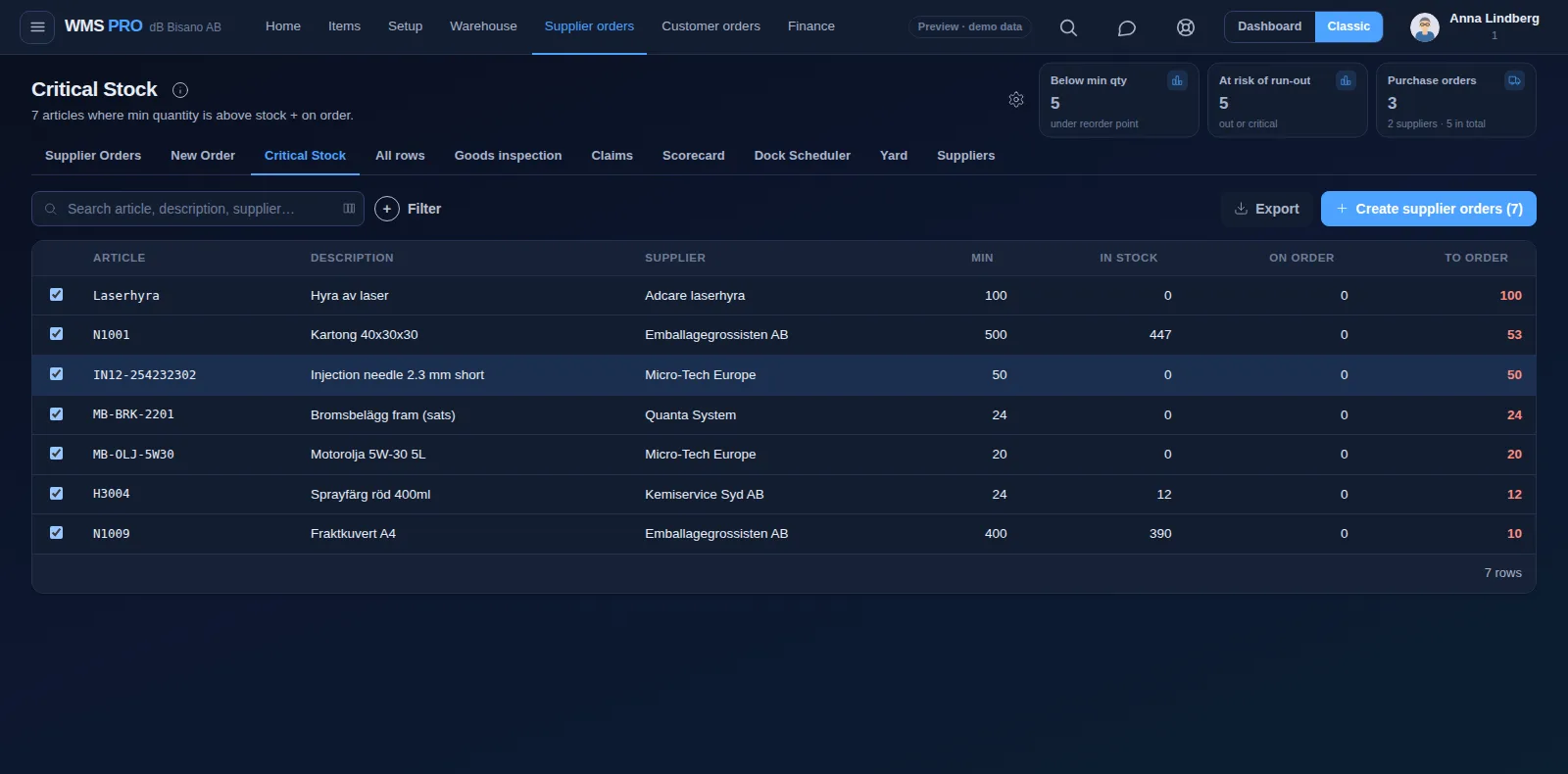
Raptool WMS gives a small warehouse that foundation. Critical Stock lists articles below their minimum and creates supplier orders in one click. Risk of Run-out compares days of cover with your lead time and suggests what to order. On the pick floor, wave picking follows the warehouse pick path, join picking merges small orders into one list, and slotting suggestions move fast sellers closer to the golden zone. Every scan feeds the data, and stock syncs both ways with Fortnox and other systems. When you want to go further, the Raptool AI Development Framework lets you describe a tool in plain words, for example a custom forecast view, and builds it as a real app on the Raptool platform.
Key takeaways
- Out-of-stocks cost sales and customers, not just one order
- AI forecasting turns sales history into timely purchase suggestions
- Most picking time is walking, so batching, routing and slotting pay off
- Scanning every step gives AI the clean data it needs
- Start small: one forecast and one pick change, then measure
Frequently asked questions
Can a small business use AI in its warehouse?
Yes. The most useful AI for a small warehouse is not robots but software: demand forecasting that suggests what to reorder and when, and pick optimisation that batches orders and shortens pick routes. Both run on data you already have, such as sales history, stock levels, supplier lead times and shelf locations.
How does AI know when to reorder a product?
AI forecasting learns the sales pattern of each product, including weekly rhythms and seasons, and estimates how many days of stock you have left. It compares that with the supplier's lead time. When the stock left will only just cover the lead time plus a safety margin, the product has reached its reorder point and the system suggests a purchase order.
How much data do I need to start with AI forecasting?
About a year of sales history, a realistic lead time per supplier and a minimum stock level per article is enough for a useful first version. Accurate stock figures matter more than a long history, so scan receiving, picking and counts.
How does AI make order picking faster?
Most picking time is spent walking. AI and pick-path rules group several small orders into one round (batch or wave picking), sort the pick lines along the shortest path through the shelves, and suggest moving fast sellers closer to packing. Research on warehouse picking shows that simple aisle-by-aisle routes can be 7 to 33 percent longer than the best route.
What is a reorder point?
A reorder point is the stock level at which you should place a new order. It equals the expected sales during the supplier's lead time plus a safety stock. AI improves it by updating the expected sales as demand changes, instead of relying on a fixed number.
What does Raptool offer for reordering and picking?
Raptool WMS lists articles below their minimum in Critical Stock and creates supplier orders in one click. Risk of Run-out compares days of cover with your lead time and suggests what to order. For picking it offers wave picking along the pick path, join picking of small orders and slotting suggestions for fast sellers. The Raptool AI Development Framework can build custom AI tools on top.
Sources: IHL Group inventory distortion study, via Supermarket News (2023); McKinsey figures on AI demand planning, via MHI Solutions (2023); de Koster, Le-Duc and Roodbergen, “Design and control of warehouse order picking: a literature review” (2007).
Tags
Want to see reorder suggestions and smarter pick lists on your own data? Book a demo and we will walk you through it.
Book a demo